
4 Things to Listen For During Decoding Instruction
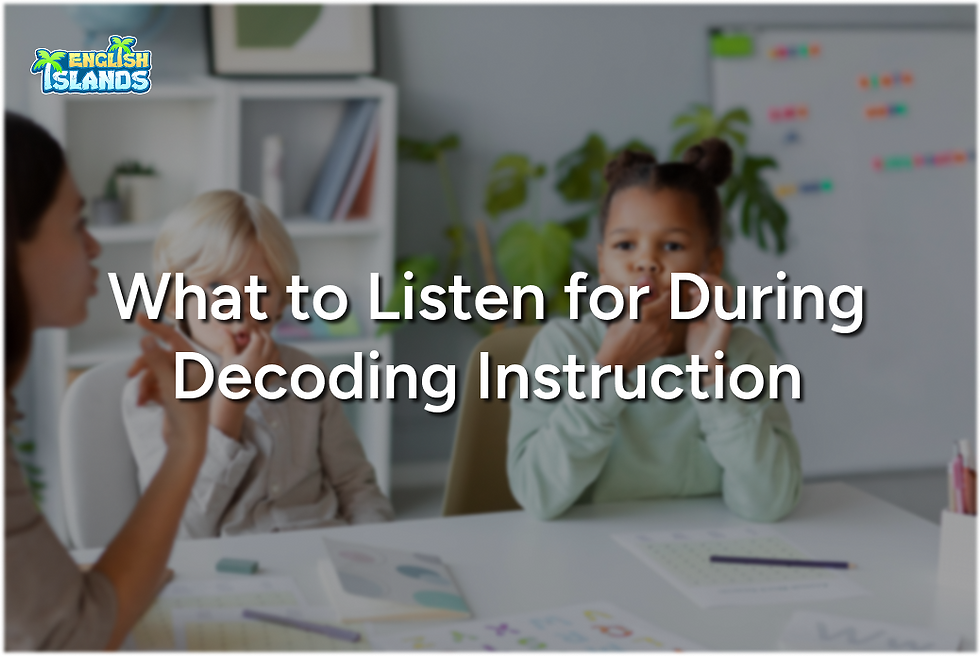
Walk into almost any literacy block and everything may appear to be running smoothly.
Students are reading.
Teachers are circulating.
The room feels productive.
Even if everything appears to be going well on the surface, peeling back a layer may reveal some things that are not so productive to literacy learning.
The good news? You don’t need to be a literacy expert to spot them.
In under two minutes, learn below how to spot signs of whether decoding instruction is truly effective.
Why Decoding “Look-Fors” Matter
Decoding is foundational. If students aren’t mastering sound-symbol relationships with precision and repetition, comprehension will eventually stall.
But the surface of a lesson can be misleading.
Fluency practice and quiet reading time can look organized and productive, even if core decoding routines are weak.
Strong instructional leadership means knowing what to listen for.
Four Things to Listen For:
1. Explicit Modeling of the Sound
When the teacher introduces a new sound and/or spelling pattern:
Is the mouth formation clear?
Is articulation precise?
Is the sound isolated and modeled intentionally?
Students may need to hear and see the sound clearly before they can produce it accurately.
If modeling is rushed, mumbled or not deliberate, some students will miss out.
2. High Repetitions Per Minute
Strong decoding lessons move quickly, but don't skimp out on repetitions.
Students should practice the new pattern multiple times per minute, not once or twice and then move on. Research demonstrates that practicing at least 1.8 times per minute is key for strengthening early reading and writing skills (Fien et al., 2015).
Listen for:
Choral responses
Practicing word chains (out loud)
Students actively practicing on white boards
Repetition builds automaticity.
3. Cumulative Review
Decoding is not “learn it once and move on.”
Strong lessons spiral back to previously taught patterns.
You should hear:
Deliberate review of previously learned patterns
Previously learned patterns embedded into new tasks
Without cumulative review, students forget.
4. Specific Error Correction
This is one of the biggest indicators of strong instruction.
When a student makes a mistake, is the correction precise?
For example, let's say a student misreads the word "ship" as "s-hip"
The teacher would ideally respond by re-teaching how the letters s and h combine together to make a brand new sound, /sh/.
This correction is clear, direct and focused on the specific letter-sound pair the student missed.
What you don't want to see is vague correction (as in saying "try again"), or just reading the full word without explaining the phonics concept that was missed (as in "that word is ship").
Specific correction builds understanding and true growth.
Literacy Leadership Doesn't Have to Mean Literacy Expert
You don’t have to know every phonics rule to lead strong literacy instruction.
Leading literacy can mean:
Learning some key research-backed techniques
Observing classrooms to see if those techniques are being implemented
Giving teachers clear, specific feedback on which techniques could be improved
The goal isn’t perfection. It’s clarity and consistency.
Use This During Your Next Observation
During your next walkthrough, challenge yourself:
Can you hear:
Clear modeling?
Students actively practicing?
Cumulative review of past concepts?
Teachers precisely correcting mistakes?
If you can, decoding instruction is likely strong. If not, that’s your coaching entry point.
Want a Simple Tool to Guide You?
Use a Decoding Walkthrough to structure your observations and follow-up conversations.
If this was helpful, feel free to share: