
Fix Letter Reversals with this 1 Simple Trick

For many early readers, b and d look almost identical.
Both letters use the same basic shapes: a vertical line and a circle. The only difference is direction.
That small difference can be surprisingly difficult for young students to remember. As a result, many beginning readers and writers reverse letters such as b and d, or p and q, while they are still developing automatic letter recognition.
The good news is that letter reversals are common in early literacy development. They do not automatically mean a child has dyslexia or a serious reading difficulty.
But they can still slow students down.
When a child has to stop and think, “Is this b or d?” they have less attention available for decoding the word, reading the sentence, and understanding the text. That is why simple, repeatable cues can be so helpful.
Why Students Confuse b and d
The letters b and d are mirror images of each other.
For adults, the difference feels obvious because letter recognition is automatic. But for early readers, letters are still new visual symbols. Students are learning that direction matters, position matters, and small changes make it a completely different letter.
This is not unusual. Young children often need time and explicit practice to learn the features that distinguish similar letters. They need to see the letters, say the sounds, write the letters, compare them, and use them in real reading and writing.
A quick physical cue can give students support while that recognition is still becoming automatic.
The Simple Hand Trick for b and d
One easy classroom strategy uses something students always have available: their hands. Here's how it works:
Ask students to give two thumbs up.
When they hold their thumbs up in front of, them their hands naturally form the shape of the letters in the correct order:
Left hand = b
Right hand = d
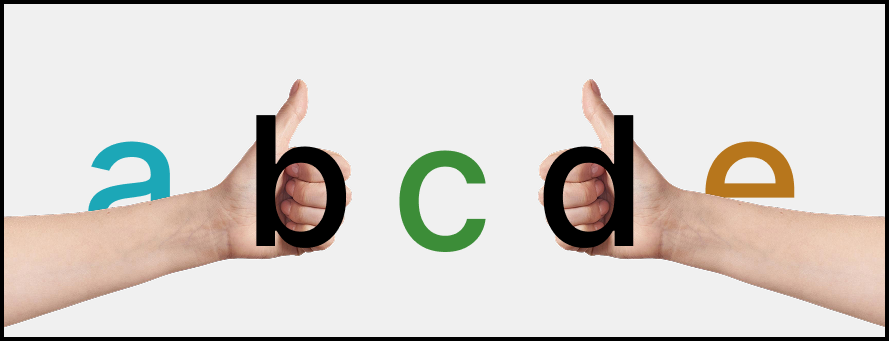
Students can quietly check their hands anytime they feel unsure. Instead of guessing, they can pause, look, and confirm which letter they are seeing or writing.
This works especially well because it gives students a visual and physical reference. They are not just trying to remember an abstract rule. They are connecting the letter shape to a concrete body cue.
It Works for p and q Too
The same strategy can support students who confuse p and q. This time, students turn their thumbs down. The letters appear in alphabetical order.
Left hand = p
Right hand = q

Now students have one consistent cue for two common reversal pairs:
Thumbs up: b and d
Thumbs down: p and q
This gives students a quick way to check letter direction during reading, spelling, and handwriting.
Why Physical Cues Help Early Readers
Physical cues can help because early letter learning is not only visual. Students often benefit from connecting what they see, say, hear, and do. For example, a student may learn a letter more securely when they:
Look at the letter shape
Say the letter name
Connect the letter to its sound
Trace or write the letter
Use a movement cue
Read the letter in words
These multisensory connections can make abstract letter forms easier to remember.
A hand cue should not replace explicit phonics instruction or handwriting practice. But it can be a useful support, especially when students are still developing confidence with visually similar letters.
What Teachers Should Remember
The hand trick is helpful, but it is not the whole solution. Students still need direct instruction and practice with letter names, letter sounds, handwriting, phonemic awareness, and decoding.
To support students with letter reversals, teachers can:
Teach one confusing pair at a time
Have students compare the letters side by side
Connect each letter to its sound
Practice reading words that contain the target letters
Practice writing the letters correctly
Use consistent verbal and visual cues
Give immediate feedback when reversals occur
The goal is not just for students to identify letters in isolation. The goal is for them to recognize letters quickly and accurately while reading and writing.
When to Be Concerned About Letter Reversals
Letter reversals are common in young children, especially in kindergarten and first grade. However, if reversals continue beyond the early grades, or if a student is also struggling with phonemic awareness, decoding, spelling, fluency, or comprehension, it may be worth gathering more information.
Persistent letter reversals alone do not diagnose dyslexia. But ongoing reading and writing difficulties should be taken seriously and addressed with evidence-based instruction and support.
Small Supports Can Build Reading Confidence
Students do not always need complex strategies. Sometimes a simple, repeatable cue gives them just enough support to keep going. The b/d and p/q hand trick helps students pause, check, and correct themselves before guessing. Over time, that confidence can help students focus less on individual letter confusion and more on the bigger goal: reading words accurately and understanding what they read.
At English Islands, we focus on helping students strengthen foundational reading skills through targeted phonics practice, real-time feedback for students and precise data for teachers. Simple classroom supports like this hand trick can work alongside strong phonics instruction to help early readers build accuracy and confidence.
FAQ
Are letter reversals normal?
Yes. Letter reversals are common among young children who are still learning to read and write. They often decrease as students receive more instruction and practice.
Do b and d reversals mean a child has dyslexia?
Not necessarily. Letter reversals alone do not mean a child has dyslexia. Dyslexia is more closely associated with difficulties in phonological processing, decoding, spelling, and fluent word recognition.
How can I help a child remember b and d?
One simple strategy is the thumbs-up hand trick. The left hand forms a b, and the right hand forms a d. This gives students a quick visual and physical cue.
Does the hand trick work for p and q?
Yes. Students can turn their thumbs down. The left hand forms a p, and the right hand forms a q.
What else helps with letter reversals?
Explicit letter instruction, handwriting practice, sound-letter practice, comparing similar letters, reading words with the target letters, and immediate corrective feedback can all support students who reverse letters.